
About
Services
Industries
Press & insights
resources
contact

We're on a mission to help companies of all sizes identify the best locations, secure incentives, obtain development approvals and optimize energy strategies through Location Economics®.
BLS & Co. serves as location and incentives advisor to Roche, Swiss multinational healthcare leader, and its subsidiary Genentech, the South San Francisco-based biotechnology industry leader. Our engagements with Roche date back to 2012, supporting over $2.7 billion in announced investments.
BLS & Co. serves aslocation and incentives advisor to Roche, Swiss multinational healthcare company, and its subsidiary Genentech, the South San Francisco-based biotechnology industry leader. Our engagements with Roche date back to 2012 with four major projects announced as of 2026:
BLS & Co. utilizes an assortment of services – a process we call Location Economics® – to advise clients on location decisions. Discover our variety of offerings to help you navigate the complex decision making processes that occur when searching for a new location for your organization.
BLS & Co. specializes in a variety of industries and our dedicated team is compromised of experts in nearly all major categories.
At BLS & Co., we have executed wide variety of projects for our clients, which includes facilities such as headquarters, warehouses, and data centers.

Stay up to date with BLS & Co. by exploring our latest news and musings on the world of site selection and more.
We're proud to provide a few key resources to help get you started on your site selection journey.
Search our North American database for the right location for your company's HQ, R&D Facilities, and more.
Browse our regional resource guide for site selection in the U.S.
If your organization is confronting complex and sensitive location decisions, please reach out to schedule a confidential conversation.
Interested in a career opportunity with BLS & Co.? Click below to learn more about our growing team and view all current openings.
As pharmaceutical manufacturers raced to expand capacity during the 2020s, a clear lesson emerged: success increasingly depended on execution. Talent quality and scalability, site readiness, utility infrastructure, permitting certainty, and the ability to bring facilities online quickly became decisive factors.
BLS brings a unique perspective to this wave based on recent experience advising major pharmaceutical manufacturers, including Lilly, Genentech, AbbVie, Johnson & Johnson, BMS and others. Since 2020, our team has evaluated more than 500 sites in virtually every state in the U.S., culminating in over 20 announced pharmaceutical sites and expansions and more than $60 billion in announced capital investments.
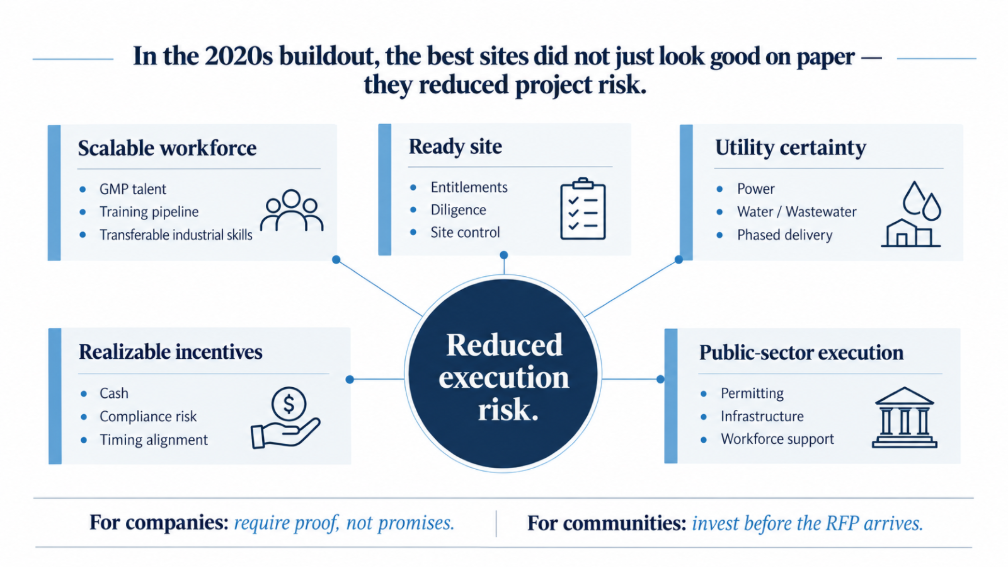
Across these projects, several themes began to emerge. Successful locations generally were selected because they offered reduced execution risk, while others fell behind because they were hampered by uncertainties. This unprecedented wave of new projects provides lessons for both companies making site selection decisions and communities hoping to attract the next major pharmaceutical investment.
The 2020s wave changed how pharmaceutical manufacturers viewed talent evaluation. Traditional measures such as labor pool size, migration patterns, wage levels, and availability of relevant occupations still mattered, but the size of the wave meant they were no longer enough. The more important question became whether a market could scale the specialized talent required for Good Manufacturing Practice (GMP) manufacturing without creating hiring delays, unsustainable wage pressure and disruptive levels of turnover.
Today, the evaluation is looking beyond established life sciences clusters. instead looking at markets with sizeable talent pools with experience in other highly regulated work manufacturing environments supported by deep pools of technical skills For traditional chemical synthesis API (Active Pharmaceutical Ingredient) facilities, for example, regions with petrochemical, specialty chemical, refining, or other process manufacturing experience may offer transferable skills in batch operations, process safety, hazardous materials handling, instrumentation, maintenance, and quality systems. GMP-specific training is still required, but adjacent industrial skill bases can materially improve workforce scalability.
At BLS, our workforce analysis tests that scalability through labor market data, hiring-ramp analysis, education and training pipeline review, competitor hiring assessment, construction labor evaluation, and market-level interviews with employers, workforce boards, community colleges, training providers, and economic development partners. The most competitive locations are now those that can prove not just available labor, but a scalable talent ecosystem aligned to the project’s technical requirements and timeline.
For large-scale projects, existing workforce resources may not be sufficient to provide companies with adequate assurance on the talent pipeline they require – a mission-critical factor in a decision on location a company will be reliant upon for many years. Increasingly, this has required public commitments to new training assets to address both the needs of a pending project and of those to follow. As a result, BLS has prioritized the need for new funding commitments to training facilities and supporting resources (e.g., equipment, staffing, linkages with other programs), a central focus of incentives negotiations, and ultimately on ranking and recommendations for successful locations.
Recent examples include North Carolina’s commitments to new pharmaceutical manufacturing training investments in support of Lilly’s choice of the Charlotte region and Johnson & Johnson’s choice of Wilson, which made both of these locations viable for the large-scale projects these companies had planned. The investments derisked the long-term workforce supply for Lilly and Johnson & Johnson, making the communities attractive for new companies with similar talent needs. Houston also learned the importance of concrete workforce commitments by nearly losing a life sciences project due to lack of a current life sciences workforce. The local team set out to remedy the training pipeline deficiency by securing a legislative funding commitment from the State of Texas for new facilities and a licensing agreement to deliver Ireland’s famed NIBRT curriculum. This new investment was a key factor in Lilly and BMS’s recently announced choices of Houston for their manufacturing projects.
The 2020s wave demonstrated that a promising site is not the same thing as a ready site. Many locations can look attractive based on acreage, highway access and/or regional positioning. Far fewer can demonstrate entitlement status, diligence record, committed utility capacities, and the permitting path required for a major pharmaceutical manufacturing facility.
For compressed project timelines, unresolved site issues can become fatal. Zoning uncertainty, incomplete environmental diligence, lack of site control, unverified geotechnical conditions, annexation requirements, wetlands constraints, or unclear utility serviceability can each create schedule risk. In a manufacturing environment where speed-to-market matters, that risk can outweigh otherwise attractive location attributes.
In many cases, the sites ultimately selected were not unknown “greenfield” discoveries. They were sites that had been considered—and passed over—by prior major projects sometimes a decade earlier. What changed was the work done in between: developers and public partners used those earlier losses to identify readiness gaps, then invested in infrastructure, due diligence, entitlement strategy, utility planning, or site control to make the location more competitive for the next major project.
Site competition is also intensifying due to demand from multiple other industries. Data centers often require large contiguous acreage, can outbid many manufacturing users and, at least until recently, were prioritized by speculative developers assembling large tracts of power-ready industrial land. Demand for industrial-appropriate land also is growing across many other industries seeking domestics production capacity, including defense and aerospace.
The lesson for manufacturers is to require proof of site readiness, not projections or promises. The lesson for communities is to invest in site readiness before a project arrives.
Over the past few years, utilities have become a critical, if not controversial, piece of the site readiness conversation across the county. Pharmaceutical manufacturing facilities are especially utility-intensive because they must support large-scale production capacity while also maintaining the redundancy and reliability needed to produce therapies on which patients depend. They are highly dependent on large continuous supply of power due to the energy intensity of the highly automated production technologies driving the manufacturing process. API facilities can also require higher levels of water and wastewater capacity to sometimes exceed a million gallons per day. Interruptions in utility services can lead to loss of critical therapies for patients and millions of dollars in lost revenue.
Recent BLS projects have shown how electric power can become a central part of the site selection process. In several instances the identification of a preferred site required more than the confirmation of available megawatts; it required developing power solutions that could satisfy both capacity and reliability requirements, including phased delivery plans, redundancy infrastructure, substation or transmission upgrades, and clear governance around who would fund, deliver and own the infrastructure.
Water and wastewater diligence also has been important. For large pharmaceutical facilities, the question is not simply whether a community has enough permitted capacity on paper; it is whether the system can support project-specific volumes, timing, discharge chemistry, and potential expansion scenarios. In practice, that means working with utilities and public partners to confirm hydraulic capacity, treatment capacity, discharge limits, chemistry compatibility, upgrading requirements, and the scheduling and committed funding to bring those commitments online.
A facility typically needs one utility profile during construction, another during commissioning and qualification, ramping up to a higher level during initial operations, and a significant increase to power full production or expansion. A site that appears highly competitive at ultimate capacity may still fail if the utility delivery schedule does not match the project ramp.
The scope of utility diligence analysis has increasingly needed to account for competition from data centers and other power-intensive users. In many markets, competition primarily from data center projects has already been tightening access to large industrial sites, electric capacity, water resources, and construction labor. For pharmaceutical manufacturers, that makes early utility strategy, queue position, and long-term infrastructure control increasingly important to site selection.
Public investment and project-specific incentives remain an important part of pharmaceutical manufacturing investment decisions. Rarely will a site have the perfect alignment of an infrastructure-ready site and an available therapeutic-specific workforce.
Although incentives can rarely make a fundamentally weak site viable, they can improve project economics, mitigate extraordinary costs, speed permitting, fund needed infrastructure, reduce risk, and help build workforce capacity. Cash grants, infrastructure funding, utility support, workforce training resources, expedited processes, and flexible performance-based tools offer more meaningful support than large nominal award values that are difficult to realize or disconnected from actual project constraints.
However, the most valuable “incentives” are often those that occur well before the project is in the site search. The states and communities with a track record of winning major pharmaceutical projects are often those that made strategic public investments years—and sometimes a decade—earlier in their site readiness, infrastructure, training facilities, and talent ecosystems. In many cases, those investments were a direct response to earlier competitive project losses, when communities were passed over for prior pharma or advanced manufacturing projects and used the feedback to address shortcomings before the next opportunity arrived.
For manufacturers, this means incentives offered by competing jurisdictions should be evaluated on a comparable basis and based on net realizable value, timing, compliance risk, and strategic relevance. For public-sector partners, it means the most competitive proposals reliably solve real project challenges.
BLS’s recent work across multiple major pharmaceutical manufacturing projects exemplifies a central lesson from the 2020s wave: successful site selection is not defined by any single advantage. Workforce, site readiness, utilities, permitting, incentives, and public-sector execution all have to be evaluated together as part of a broader view of project risk.
For companies, that means moving beyond headline comparisons of cost, labor availability or incentive value and asking which locations can actually support the technical requirements, business case and schedule. For communities, it means the most competitive proposals are built long before an RFP arrives through disciplined investments in site readiness, utility infrastructure, workforce systems, and permitting coordination, and then reinforced with project-specific incentives to make each location as competitive as they can be.
The next question is what happens after those projects come online. As today’s facilities reach operating scale, the strategic challenge for companies may shift from building capacity to optimizing, repurposing, acquiring, or rationalizing the manufacturing networks created during this expansion cycle. For communities, the implication is equally important: how they respond to these shifts will help determine how well they are positioned for the next phase of investment in the 2030s.
Jay is the Executive Managing Director at Biggins Lacy Shapiro & Co., one of the most highly regarded site selection and incentives advisory firms in North America. BLS & Co. helps manage the complexities associated with finding optimal locations and securing incentives to support new ventures.
Since joining the firm in 2015, Kyle has worked with clients in various capacities in the firm’s site selection and incentive advisory practices to optimize value in location decisions for client projects including headquarters, data centers, office and industrial facilities.
We're on a mission to help companies of all sizes identify the best locations, secure incentives, obtain development approvals and optimize energy strategies through Location Economics®.
BLS & Co. serves as location and incentives advisor to Roche, Swiss multinational healthcare leader, and its subsidiary Genentech, the South San Francisco-based biotechnology industry leader. Our engagements with Roche date back to 2012, supporting over $2.7 billion in announced investments.
BLS & Co. serves aslocation and incentives advisor to Roche, Swiss multinational healthcare company, and its subsidiary Genentech, the South San Francisco-based biotechnology industry leader. Our engagements with Roche date back to 2012 with four major projects announced as of 2026:
BLS & Co. utilizes an assortment of services – a process we call Location Economics® – to advise clients on location decisions. Discover our variety of offerings to help you navigate the complex decision making processes that occur when searching for a new location for your organization.
BLS & Co. specializes in a variety of industries and our dedicated team is compromised of experts in nearly all major categories.
At BLS & Co., we have executed wide variety of projects for our clients, which includes facilities such as headquarters, warehouses, and data centers.
Stay up to date with BLS & Co. by exploring our latest news and musings on the world of site selection and more.
We're proud to provide a few key resources to help get you started on your site selection journey.
Search our North American database for the right location for your company's HQ, R&D Facilities, and more.
Browse our regional resource guide for site selection in the U.S.
If your organization is confronting complex and sensitive location decisions, please reach out to schedule a confidential conversation.
Interested in a career opportunity with BLS & Co.? Click below to learn more about our growing team and view all current openings.


