
About
Services
Industries
Press & insights
resources
contact

We're on a mission to help companies of all sizes identify the best locations, secure incentives, obtain development approvals and optimize energy strategies through Location Economics®.
BLS & Co. serves as location and incentives advisor to Roche, Swiss multinational healthcare leader, and its subsidiary Genentech, the South San Francisco-based biotechnology industry leader. Our engagements with Roche date back to 2012, supporting over $2.7 billion in announced investments.
BLS & Co. serves aslocation and incentives advisor to Roche, Swiss multinational healthcare company, and its subsidiary Genentech, the South San Francisco-based biotechnology industry leader. Our engagements with Roche date back to 2012 with four major projects announced as of 2026:
BLS & Co. utilizes an assortment of services – a process we call Location Economics® – to advise clients on location decisions. Discover our variety of offerings to help you navigate the complex decision making processes that occur when searching for a new location for your organization.
BLS & Co. specializes in a variety of industries and our dedicated team is compromised of experts in nearly all major categories.
At BLS & Co., we have executed wide variety of projects for our clients, which includes facilities such as headquarters, warehouses, and data centers.

Stay up to date with BLS & Co. by exploring our latest news and musings on the world of site selection and more.
We're proud to provide a few key resources to help get you started on your site selection journey.
Search our North American database for the right location for your company's HQ, R&D Facilities, and more.
Browse our regional resource guide for site selection in the U.S.
If your organization is confronting complex and sensitive location decisions, please reach out to schedule a confidential conversation.
Interested in a career opportunity with BLS & Co.? Click below to learn more about our growing team and view all current openings.
How innovation, tax reform, industrial policy, and federal pressure shifted investments back toward the U.S.
The first half of this decade witnessed an unprecedented level of announced new investments in US-based pharmaceutical production capacity. The surge in investment in pharma manufacturing was not the product of a single catalyst. It emerged as years of scientific innovation, tax reform, supply-chain risk, and federal policy pressures converged to produce a burst of investment commitments concentrated over an unprecedent five-year period.
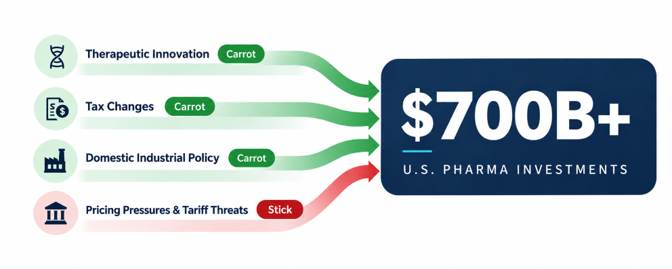
Four forces converged:
Together, these forces changed the manufacturing question from how much capacity pharma needed to where that capacity needed to be built.
Life sciences’ past six years have been marked by transformative events such as the COVID-19 pandemic, the rise of GLP-1s, and continued advances in immunotherapies and other next-generation treatments. Additionally, new approvals and drug pipelines drove investment in peptide production as well as diverse new biologics, antibody-based therapies, radiopharmaceuticals, and other specialized platforms. Together, these factors have quickly increased pressure on existing manufacturing platforms built for older product portfolios.
However, in most cases, the production of innovative new therapies was not interchangeable with existing manufacturing facilities and networks tailored towards legacy medicines or with insufficient scale. A facility that works well for one therapy may not support another without substantial retrofits, upgrades in utilities that may not be feasible, different workforce requirements, modified logistics and/or additional permitting considerations. As the industry’s product portfolio became more complex, the manufacturing footprint needed to become more specialized and more flexible at the same time. Surging patient demand also required spaces to be delivered more quickly than past projects.
The result was a massive demand for new facilities requiring multibillion-dollar investments to add new capacity aligned to new science, new product formats, and new market expectations for speed and quality.
For years, many pharmaceutical companies located manufacturing, intellectual property, and profits in low cost and/or tax-advantaged jurisdictions such as Ireland, Singapore, Puerto Rico, and Switzerland. Those locations often made operational sense, but tax efficiency was also a major factor in global network design.
The 2017 Tax Cuts and Jobs Act (TCJA) changed part of that equation by lowering the U.S. corporate tax rate from 35% to 21% and reducing some of the benefits of keeping profits and business activity offshore. As we noted in a prior LinkedIn post on how the TCJA was impacting U.S. site selection decisions, the law reshaped the after-tax economics of U.S. investment. Lilly CEO Dave Ricks later made the connection directly, saying the 2017 TCJA “has been foundational to Lilly’s domestic manufacturing investments.” Other global tax changes outside of the US have minimized the value of offshore alternatives.
At the same time, the U.S. remains the world’s largest pharmaceutical market by revenue, accounting for roughly half of global prescription drug spending. Together, those changes strengthened the case for “produce where you sell” strategies and made U.S. manufacturing capacity more strategically attractive.
The pandemic turned the geographically complexities of pharmaceutical supply-chains from an operational concern into an industrial and public health policy priority. Federal and state stakeholders increasingly viewed domestic medicine production as part of a broader resiliency strategy, creating momentum for projects tied to supply-chain security, infrastructure investment, workforce development, job creation, and long-term economic development.
States responded with targeted tools. In Texas, voter approval in 2023 of Proposition 10 authorized a personal property tax exemption for qualifying medical and biomedical manufacturing equipment and inventory, reducing a major operating-cost burden for capital-intensive projects. Other states, including North Carolina, expanded pharma manufacturing workforce training programs or looked to models such as Ireland’s National Institute for
Bioprocessing Research & Training (NIBRT) to build specialized talent pipelines.
Federal policy moved in the same direction. The FDA PreCheck program, announced in 2025, was designed to strengthen domestic pharmaceutical supply chains by improving regulatory predictability and giving manufacturers earlier FDA engagement during facility design, construction, and pre-production. Together, these tools reflected a shift from traditional incentives alone toward policies that reduce execution risk and cost while improving the odds that complex projects can be delivered on schedule.
The Trump administration’s Most-Favored-Nation drug pricing policies added another lever to the domestic manufacturing equation. Beginning with agreements announced in 2025, major pharmaceutical manufacturers agreed to provide reduced prices on certain drugs and for U.S. patients covered under state Medicaid programs benchmarked to the lowest prices paid in other developed countries.
In exchange, companies received protection from threatened pharmaceutical-specific tariffs, generally conditioned on new U.S. manufacturing, research, and development investment commitments. The structure of these the broader message that market access, pricing policy, trade policy, and manufacturing footprint strategy were becoming increasingly linked. For site selection, the significance is that federal policy was no longer limited to grant programs, tax incentives, or regulatory reforms; it was also using trade and pricing leverage to influence where companies located future capacity.
These dynamics – the convergence of scientific innovation that required new kinds of facilities, tax changes that improved the case for U.S. reinvestment, domestic industrial policy that rewarded onshoring, as well as federal pricing and trade pressure -- catalyzed a concentrated level of investment decisions in the US that far exceeded any normal cyclical upswing.
That convergence explains why so many companies announced major investments in the same window. The next question is how those commitments become real projects: which sites can support the required workforce, site readiness, infrastructure, permitting path, utility profile, and execution timeline? That question sits at the center of BLS’s recent work advising pharmaceutical manufacturers, including Lilly, Genentech, AbbVie, Johnson & Johnson, BMS, and others, on location strategy for more than 15 announced investments since 2020.
The longer-term question is what happens after the wave crests. Because many of the largest facilities announced in the mid-2020s may not reach full operating scale until the 2030s, the industry’s strategic focus may shift from creating capacity to optimizing, repurposing, acquiring, or rationalizing it.
Jay is the Executive Managing Director at Biggins Lacy Shapiro & Co., one of the most highly regarded site selection and incentives advisory firms in North America. BLS & Co. helps manage the complexities associated with finding optimal locations and securing incentives to support new ventures.
Since joining the firm in 2015, Kyle has worked with clients in various capacities in the firm’s site selection and incentive advisory practices to optimize value in location decisions for client projects including headquarters, data centers, office and industrial facilities.
We're on a mission to help companies of all sizes identify the best locations, secure incentives, obtain development approvals and optimize energy strategies through Location Economics®.
BLS & Co. serves as location and incentives advisor to Roche, Swiss multinational healthcare leader, and its subsidiary Genentech, the South San Francisco-based biotechnology industry leader. Our engagements with Roche date back to 2012, supporting over $2.7 billion in announced investments.
BLS & Co. serves aslocation and incentives advisor to Roche, Swiss multinational healthcare company, and its subsidiary Genentech, the South San Francisco-based biotechnology industry leader. Our engagements with Roche date back to 2012 with four major projects announced as of 2026:
BLS & Co. utilizes an assortment of services – a process we call Location Economics® – to advise clients on location decisions. Discover our variety of offerings to help you navigate the complex decision making processes that occur when searching for a new location for your organization.
BLS & Co. specializes in a variety of industries and our dedicated team is compromised of experts in nearly all major categories.
At BLS & Co., we have executed wide variety of projects for our clients, which includes facilities such as headquarters, warehouses, and data centers.
Stay up to date with BLS & Co. by exploring our latest news and musings on the world of site selection and more.
We're proud to provide a few key resources to help get you started on your site selection journey.
Search our North American database for the right location for your company's HQ, R&D Facilities, and more.
Browse our regional resource guide for site selection in the U.S.
If your organization is confronting complex and sensitive location decisions, please reach out to schedule a confidential conversation.
Interested in a career opportunity with BLS & Co.? Click below to learn more about our growing team and view all current openings.


